Nowhere on the Belgian coast do you feel the Belle Époque as strongly as in the Concessie, the green villa district that turned De Haan into an elegant seaside resort around 1900.
How it began: read how the Concessie was born in 1889 from fifty hectares of dunes, with strict rules that still protect its green character.
The villas: discover the cottage villas with their half-timbering, bay windows and verandas, such as Villa Beau Site and Villa Béatrice.
The heart of the district: the 1902 tram station and the Koninklijk Plein are De Haan's calling card.
The Concessie started as a bold plan to build a resort in empty dunes, and the tram turned that plan into reality.
The tram makes it possible: from 8 August 1886 a steam tram ran between Ostend and Blankenberge, making the dunes near Klemskerke accessible for the first time.
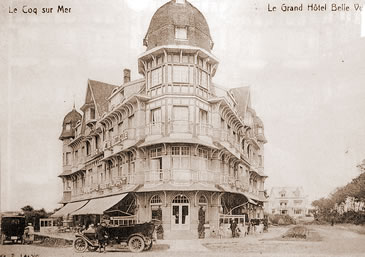
A new resort (1888): on 22 July 1888 the resort and its first hotel officially opened, under the French name Le Coq-sur-Mer.
The 1889 concession: by Royal Decree of 29 July 1889 the Belgian State granted fifty hectares of dunes on a ninety-year lease to the architects Eduard Colinet and Passenbronder. It was the first large leasehold project in Belgium, and the district owes its name to it.
Strict rules: only a sixth of the land could be built on, with detached villas instead of terraced houses, so that plenty of dune and woodland remained between the houses.
Stübben's plan (1910): the German town planner Joseph Stübben, who also worked for King Leopold II, drew up the extension plan with winding avenues in 1910. High-rise buildings were ruled out and as much woodland as possible was kept as shelter from the wind.
Visitors from abroad: English and French tourists in particular found their way to De Haan. For them came a casino (1899), the Sint-Monicakerk (1902) and, in 1903, the Royal Ostend Golf Club in the dunes near Vosseslag.
Cottage-style villas
What makes the Concessie so special are its many detached villas, most of them built between 1890 and the 1930s.
The cottage style: most villas are built in a rural cottage style, with steep pitched roofs, imitation half-timbering, bay windows, wooden canopies, verandas and small-paned windows.
Villa Béatrice (1897): on the Grotestraat stands one of the oldest holiday villas in De Haan, built in 1897 for a Brussels bookseller. It has been a protected monument since 2003.
Villa Beau Site (1913): the local architect Neirynck built this villa at Stationsstraat 23 for himself, with a playful roofscape, a loggia and projecting bays.
The row on the Driftweg: the holiday houses on the Driftweg and the Stationsstraat, built between 1900 and the 1930s, frame the view of the tram station and are protected together as a townscape.
The Rembrandtlaan: the villas at numbers 10 to 19 on the Rembrandtlaan are protected too. Many avenues in the Concessie are named after a painter or writer, such as the Rubenslaan, the Rafaëllaan and the Shakespearelaan.
Famous residents: in 1933 Albert Einstein lived in villa Savoyarde on the Shakespearelaan, and he was photographed with James Ensor in the garden of Au Cœur Volant on the Normandiëlaan.
The tram station and the Koninklijk Plein
In the middle of the Concessie lie the places everyone knows from the postcards of De Haan.
The tram station (1902): the Brussels architect Georges Dhaeyer designed the elegant little station building in Anglo-Norman style. It is the only old tram station in Belgium where a regular tram still stops, namely the Coastal Tram.
Saved just in time: in 1977 the station was threatened with demolition. The municipality bought it, and since 1981 it has been a protected monument.
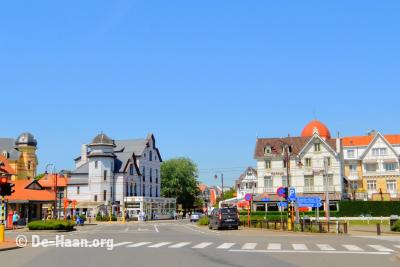
The Koninklijk Plein: from the tram station the axis of the district runs across the Koninklijk Plein to the promenade. On the square stand the protected kiosks from the days of the casino, which stood here from 1899 to 1929.
Hotel Belle Vue: on the square is the Belle Vue hotel, where the painter James Ensor had his daily coffee and where Einstein liked to sit on the terrace in 1933.
The town hall: the former Grand Hôtel, later Home Espérance, at Leopoldlaan 24 was bought by the municipality in 1979, restored in 1985 and is now the town hall.
The Sint-Monicakerk: the Augustinian fathers built the neo-Gothic Sint-Monicakerk on the Monicastraat between 1899 and 1902; it was extended in 1934.
How the Concessie was saved
That the Concessie is still so intact is thanks to residents who resisted the building boom of the 1970s.
A wake-up call in concrete: when the modernist Mayfair apartment block replaced a villa on the promenade, fears grew that the whole district might disappear.
The action committee (1977): on 14 November 1977 residents founded the Actiecomité voor het behoud van de Concessie. A petition in 1979 was signed by 1,500 people.
The end of the concession (1979): on 29 July 1979 the ninety-year lease expired, and the future of the district passed to the municipality.
Protected townscape (1981): on 24 June 1981 the heart of the Concessie was protected as a townscape. The protected zone was extended in 1995, and in 2003 the Driftweg, Villa Beau Site and Villa Béatrice followed.
Support for owners: since 2011 a heritage enhancement plan has given owners grants for the upkeep of their villas, just as for a listed monument.
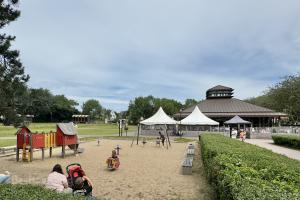
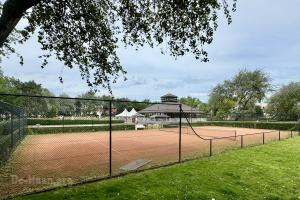
A park for everyone: in 2000 the municipality bought the La Potinière park, which has been public ever since.
Belle Époque walk through the Concessie
Seven places that together tell the story of the Belle Époque in De Haan, all within walking distance of the tram stop.
De Haan aan Zee tram station
The protected 1902 station building by Georges Dhaeyer, with its half-timbering and overhanging roofs. This is where the axis of the Concessie begins.
Koninklijk Plein
The square with the old casino kiosks and the Belle Vue hotel, where James Ensor and Albert Einstein drank their coffee.
Town hall; Leopoldlaan 24
The former Grand Hôtel and Home Espérance, one of the great hotels from the resort's early years, now De Haan's town hall.
Villa Beau Site; Stationsstraat 23
The cottage villa that architect Neirynck built for himself in 1913. Around the corner are the protected holiday houses of the Driftweg.
Villa Béatrice; Grotestraat 3
One of De Haan's first holiday villas, from 1897, with dormers, barge boards and small window panes.
Sint-Monicakerk; Monicastraat
The neo-Gothic church that the Augustinian fathers built between 1899 and 1902 for the growing resort.
Leopoldplein
The end point, in the greenery of the villa district. From here you can stroll along the winding avenues to the Shakespearelaan and the Normandiëlaan, or to the promenade.
About this route
A relaxed walk through the finest villa district on the coast, easy to combine with a terrace or an afternoon by the sea.
Distance and duration: allow about 2 to 3 kilometres and an hour to an hour and a half, with time to look around.
Start and finish: you start at the De Haan aan Zee stop, which you can reach by Coastal Tram from any resort on the coast.
Respect the residents: almost all the villas are private or holiday homes. Please view them from the street.
Take your time: the avenues are quiet and leafy. Some of the finest villas are found between the stops.
Combine with a terrace: on and around the Koninklijk Plein you will find charming terraces; more tips are on the food and drink page.
Want to see more
Around the Concessie there are more places that complete the story of the resort.
Albert Einstein: follow the Einstein walking route past villa Savoyarde, Au Cœur Volant and his statue on the Normandiëlaan.
La Potinière park: the green La Potinière park in the Concessie is a lovely place to rest, with a playground for the children.
More history: from the polder villages to the 1977 merger, read all about it on the page about the history of De Haan.
Vosseslag lighthouse: cycle through the dunes to the Vosseslag lighthouse, close to the golf course King Leopold II had laid out here.