While Albert Einstein (1879 to 1955) was teaching in America in early 1933, Germany quickly became a country where he was no longer safe.
Hitler in power: while Einstein was in the United States, the Nazis came to power. His house near Berlin was searched and his possessions were confiscated.
Arrival in Antwerp: at the end of March 1933 he arrived in Antwerp on the Red Star Line ship Belgenland. He never went back to Germany.
Farewell to Germany: shortly after arriving he renounced his German citizenship in Brussels and resigned from the University of Berlin.
First in Mortsel: for the first days the family stayed with the Ghent professor Arthur De Groodt and his wife at Cantecroy castle in Mortsel. Mrs De Groodt then found them a villa by the sea.
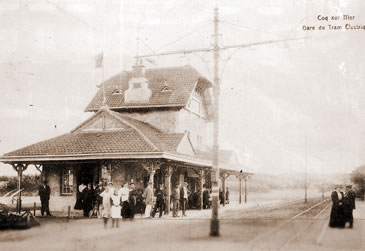
By tram to the sea: Einstein took the train to Ostend and from there the Coastal Tram to De Haan, which at the time was mostly known by its French name Le Coq-sur-Mer.
Half a year in villa Savoyarde
From April to September 1933 Einstein lived in villa Savoyarde at Shakespearelaan 3, in the heart of the Concessie villa district.
With the whole household: he lived there with his wife Elsa, his stepdaughter Margot and his secretary Helen Dukas. The De Groodt family rented villa La Maisonnette in the same street.
Guarded by the gendarmerie: the Nazis regarded him as an enemy of the regime, and there were rumours of a bounty on his head. From 12 April 1933 the De Haan gendarmerie was tasked with discreetly ensuring his safety.
Hard to protect: two officers followed him everywhere, but Einstein sometimes went for a walk along the promenade at two or three in the morning without telling anyone.
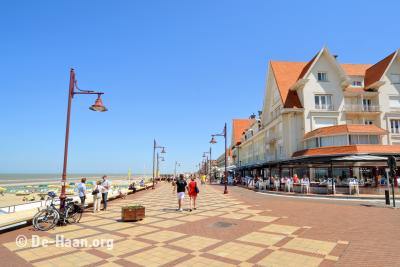
An ordinary day: in the mornings he walked on the beach or the promenade, and he liked to have coffee on the terrace of the Belle Vue hotel by the tram stop.
The house today: the villa still stands and is a private home. An information panel by the street tells the story of his stay.
Visitors, music and a quarrel with Ensor
Even in exile Einstein remained a celebrated man, and the villa on the Shakespearelaan attracted many visitors.
Artists and writers: he received the painters James Ensor, Félix Labisse and Alfons Blomme, among others, and the British writer Aldous Huxley.
Queen Elisabeth: Einstein knew the Belgian royal couple from the Solvay conferences in Brussels. He shared a love of the violin with Queen Elisabeth, and the two played music together. She too visited him in De Haan.
Dinner at Au Cœur Volant: on 2 August 1933 Einstein dined with James Ensor at villa Au Cœur Volant on the Normandiëlaan. The two disagreed about colour and mathematics, and Ensor left early.
Appearances in Ostend: he gave a lecture to the Rotary Club in Ostend, played the violin at a concert in the Kursaal and took a boat trip at sea on the Zinnia.
Departure in September: when a German philosopher who had fled to Czechoslovakia was murdered on Nazi orders at the end of August 1933, Einstein no longer felt safe in Belgium either. On 8 September 1933 he left for England, and a month later for America.
Never back: Einstein went on to work in Princeton and never set foot in Europe again. He died there on 18 April 1955.
The statue and other reminders
De Haan is proud of its famous guest, and you can see that in several places.
Einstein on a bench: on 16 December 2006 a bronze statue by Johnny Werbrouck was unveiled in a small park on the Normandiëlaan. Einstein sits on a bench, looking as he did during his summer by the sea. There is room next to him for a photo.
Imagination over knowledge: next to the statue is his famous saying that imagination is more important than knowledge.
On film: De Haan was the setting for several documentaries and for an East German feature film about Einstein from 1988.
As a comic: in 2023 the comic album Le Coq-sur-Mer, 1933 by Rudi Miel and Baudouin Deville was published, telling the story of his exile as a thriller.
More history: read about how the resort came into being and its other great moments on the page about the history of De Haan.
Einstein walking route through De Haan
Five places directly linked to his stay, all within walking distance of each other in the Concessie.
De Haan aan Zee tram stop
This is where Einstein got off the Coastal Tram in the spring of 1933. The elegant Belle Époque station building is still standing.
Hotel Belle Vue; Koninklijk Plein
Einstein liked to have his coffee on the terrace of this hotel. James Ensor also came here regularly for coffee and a raisin bun.
Villa Savoyarde; Shakespearelaan 3
The house where Einstein lived from April to September 1933 with Elsa, Margot and Helen Dukas. The information panel by the street shows a photo of Einstein at one of the windows.
Au Cœur Volant; Normandiëlaan 25
The villa where Einstein and James Ensor dined together on 2 August 1933 and fell out over colour and mathematics.
Statue of Albert Einstein; Normandiëlaan
The end of the route: Einstein in bronze on a bench, a few steps from Au Cœur Volant. Take a seat next to him for a moment.
About this route
A short walk through the finest villa district on the Belgian coast, easy to combine with a day at the beach.
Distance and duration: about 1 kilometre, a fifteen minute walk without stops. Allow an hour if you read the information panels and stop for a coffee.
Start and finish: you start at the De Haan aan Zee stop, easily reached by Coastal Tram, and finish at the statue on the Normandiëlaan.
Look up: the Concessie was laid out at the end of the 19th century with winding avenues, detached villas and plenty of greenery. Almost all the villas Einstein saw are still there.
Respect the residents: villa Savoyarde and Au Cœur Volant are private homes. Please view them from the street.
Do as Einstein did: finish with a walk along the promenade and the beach, just as he did every morning.
Want to see more
If you fancy more after the route, there is plenty in and around De Haan to complete the story.